×



Prediction markets have moved beyond politics. In 2026, sports fans can trade contracts on game outcomes, player performance, and other events, while the same platforms may also offer markets on elections, economic data, crypto, and weather.
If you are looking for the best prediction markets, our top three picks are Kalshi, Polymarket US, and DraftKings Predictions. Kalshi is our best overall pick, Polymarket US stands out for market variety, and DraftKings Predictions is particularly easy for sports bettors to understand.
However, the catch is that these prediction markets aren’t simply sportsbooks with different odds. Their pricing, fees, trading mechanics, and legal status work differently.
| Platform | Best for | Regulatory Status | Effective Fee | Sports Markets | Our Ratings |
|---|---|---|---|---|---|
| Kalshi | Best overall | CFTC-registered DCM | ~1–2% of position value, varies by market | Extensive | 9.4 |
| Polymarket US | Market variety | CFTC-registered DCM | Market-specific | Extensive | 9.2 |
| DraftKings Predictions | Sports bettors | Introducing Broker structure | Contract/exchange fees | Extensive | 8.9 |
| ProphetX | Sports trading | CFTC-registered DCM | 2% of net profits; 0% on combos | Sports-focused | 8.6 |
| Novig | Sports-first users | CFTC-registered DCM | Market-specific | Sports-focused | 8.4 |
| OG.com | Sports+ event markets | NADEX/CFTC-regulated | ~$0.02 per $1 in and out | Strong | 8.2 |
Our pick: Kalshi for the best all-around mix of sports and non-sports markets.
Sports pick: DraftKings Predictions for bettors who want a familiar sports-first experience.
Market-variety pick: Polymarket US.
A prediction market is a platform where people trade contracts based on the possible outcome of a future event. For example, users might buy contracts on whether a candidate will win an election, whether Bitcoin will reach a certain price, or whether a sports team will win.
The price of a contract reflects the market’s estimated probability of this outcome. If a contract trades at $0.70, it roughly suggests a 70% chance of the event happening.
Prices can move as news comes in, teams announce lineups, economic data changes, or election expectations shift. This is where terms such as order book, bid-ask spread, maker/taker, settlement fee, binary contract, and implied probability become useful.
Finally, when the event is concluded, contracts tied to the correct outcome pay out, while incorrect ones become worthless. Prediction markets use collective opinions and money to forecast real-world events.
You don’t need a finance degree to trade these markets, but you should know what each number on the screen means before putting money behind it.
The main difference between a prediction market and a sportsbook is how each market is structured.
The sportsbooks usually act as the house. You receive a quoted price and accept it. If you see an NFL side at -110, for example, you are risking $110 to win $100.
On a two-sided market, -110 on both sides gives the sportsbook a hold of roughly 4.55%, or about $4.55 on every $100 of two-way handle. That is the number to compare a prediction market’s fees against.
Prediction markets, in contrast, work differently. They are usually structured around contracts traded through an exchange-linked platform. Instead of simply accepting a sportsbook’s price, traders buy and sell contracts as market prices move.
This means there isn’t necessarily a traditional sportsbook-style vig built in the same way. But it would be a mistake to translate that into “prediction markets are free,” because they are not.
Platforms can charge transaction fees, exchange fees, or other costs, while the bid-ask spread can also affect the price you actually receive.
For example, Kalshi earns revenue through transaction fees rather than taking a financial position on an event’s outcome. Its fee schedule can vary by market, including special events and major sporting competitions.
Polymarket US uses different models. For certain markets, the platform charges taker fees while makers are not charged, with the fee calculated using the number of contracts, contract price, and applicable fee rate. Sports currently carry a 5% taker fee rate under this formula.
Prediction markets let you sell a position before the event settles. Robinhood, for example, explains that event contracts can be bought and sold before expiration, while Polymarket also allows users to close positions before resolution. This is not the same thing as a sportsbook’s promotional “cash out” option.
In an exchange-style market, you are looking for another participant willing to trade at the available price. If liquidity is thin, your desired exit price may not be available.
This is what complicates the whole process. The CFTC regulates qualifying derivatives markets under the Commodity Exchange Act. Platforms can operate through structures including a Designated Contract Market (DCM), Derivatives Clearing Organization (DCO), futures commission merchant, or Introducing Broker.
Kalshi has been a CFTC-designated DCM since November 3, 2020. The CFTC also lists QCX LLC, doing business as Polymarket US, as a designated DCM. But the catch here is that a federal registration does not mean state-level disputes disappear.
States such as Nevada have argued that sports event contracts can function like traditional sports gambling and therefore fall within state gambling regulation. That argument prevailed on 28 August 2026, when a unanimous three-judge Ninth Circuit panel held in KalshiEX LLC v. Assad that Kalshi’s sports event contracts are not “swaps” under the Commodity Exchange Act, allowing Nevada to enforce its gambling laws against them.
The panel issued parallel decisions covering Crypto.com’s derivatives unit and Robinhood Derivatives. The ruling directly contradicts the Third Circuit’s 2-1 decision of 6 April 2026 in KalshiEX LLC v. Flaherty, which found the opposite. On 2 September 2026, New Jersey filed a 332-page petition asking the Supreme Court to resolve the split.
So, for consumers, “federally regulated” and “available everywhere” are two very different statements.
Age requirements can also vary by platform and jurisdiction. Minimum age varies by platform, not just by state. Most prediction markets accept users at 18+, while some, including Novig, require 21+. Check the individual platform before registering.
Sports market depth is one of the biggest differences between today’s prediction market apps. If you are coming from sports betting, you probably care about more than whether a platform has “sports.”
You want to know whether it has the leagues you follow, the markets you actually trade, enough liquidity to get in and out, and whether it offers combinations or live markets.
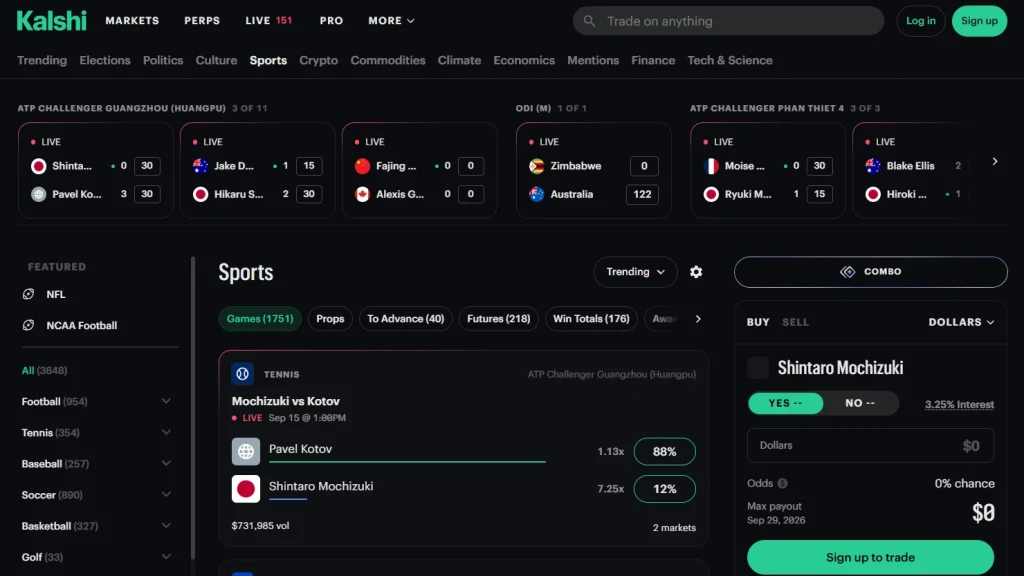
Kalshi earns our top spot because it does something still relatively unusual in this category: it combines a serious sports offering with a much broader event marketplace.
The CFTC lists Kalshi as a designated contract market, with its designation dating to November 3, 2020.
For sports bettors, Kalshi offers contracts around sporting events while also covering politics, economics, finance, weather, and other categories.
Its combo builder is particularly relevant to sports bettors. According to Kalshi, combos allow users to combine eligible events into one position, with each combo having its own order book. The platform uses a request-for-quote system to price combos rather than simply applying a sportsbook-style parlay formula.
This difference is worth remembering. A prediction-market combo is not automatically the same thing as a sportsbook parlay.
Fees are market-specific, so no single flat Kalshi fee applies to every trade. Some markets, including major sporting events, can have different fee schedules. State availability is also changing as litigation continues.

Polymarket US is the strongest alternative for users who want a wide range of markets. The key distinction is Polymarket US, not the international Polymarket platform. The CFTC lists QCX LLC, doing business as Polymarket US, as a designated contract market.
Sports are part of the offering, but the platform’s appeal goes well beyond sports. Traders can find markets around politics, economics, finance, crypto, culture, and other events.
Its pricing system is also very exchange-like. Polymarket’s current fee schedule charges taker fees on certain categories, while makers are not charged and can receive rebates. Sports currently have a 5% taker fee rate under the platform’s probability-weighted formula.
Polymarket also supports combinations in eligible markets, giving sports users another way to build multi-event positions.
The big weakness is the same thing that makes Polymarket interesting: there is more to learn. Someone who only knows sportsbook odds may need a little time to understand order books, spreads, and maker/taker mechanics.


DraftKings Predictions is perhaps the easiest bridge between conventional sports betting and prediction markets. The sports angle is obvious. The platform offers event contracts tied to sporting events, but it also lists financial and other event markets. DraftKings market pages show contracts that can settle at $0 or $1 based on defined outcomes. This is useful for bettors because the basic Yes/No structure is easy to understand.
However, the regulatory structure differs from that of Kalshi and Polymarket US. DraftKings Predictions does not operate as a DCM in its own right. Its product uses an Introducing Broker structure connected to the regulated event-contract market.
The platform also publishes state and market availability information, which matters because not every prediction contract is necessarily offered everywhere. Its biggest strength is the sports experience.
The weakness is that users looking for a huge range of political, economic, and niche event markets may find broader platforms more interesting.


OG.com takes a slightly different route. Its own legal disclosure says prediction contracts are derivatives offered by North American Derivatives Exchange (NADEX), a CFTC-regulated exchange, with OG.com operating under the OG Prediction Markets brand and providing the technology.
This structure matters because OG.com should not be described as an independent DCM.
The platform offers sports and other event markets, with availability varying by state. OG.com’s educational material says sports contracts aren’t available in every state and that some jurisdictions have broader restrictions.
For users, the main appeal is access to CFTC-regulated event contracts through a sports-friendly interface.
| Platform | Sports Coverage | Player Props | Live/In-Game | Combo/Parlay-Style Markets | Early Exit |
|---|---|---|---|---|---|
| Kalshi | Broad | Yes, market-dependent | Yes, market-dependent | Yes | Yes |
| Polymarket US | Broad | Market-dependent | Market-dependent | Yes | Yes |
| DraftKings Predictions | Broad | Market-dependent | Market-dependent | Market-dependent | Yes |
| ProphetX | Sports-focused | Yes | Yes | Yes | Market-dependent |
| Novig | Sports-focused | Market-dependent | Market-dependent | Market-dependent | Market-dependent |
| OG.com | Sports-focused | Market-dependent | Market-dependent | Market-dependent | Yes |
Here, “Yes” means that the platform supports the feature in at least some eligible markets. It does not mean every sport, league, or event offers that feature.
There are now far more prediction market platforms than the original Kalshi-versus-Polymarket comparison suggests.
| Platform | Type/Structure | Main Categories | Access | State Availability |
|---|---|---|---|---|
| Kalshi | DCM | Sports, politics, economics, finance, weather | Web/app | Varies |
| Polymarket US | DCM | Sports, politics, finance, crypto, culture | Web/app | Varies |
| DraftKings Predictions | Introducing Broker structure | Sports, finance, crypto and events | Web/app | Varies |
| FanDuel Predicts | FCM | Sports, finance, crypto and events | Web/app | Varies |
| Fanatics Markets | Prediction-market offering | Sports and events | Web/app | Varies |
| ProphetX | DCM | Sports | Web/app | Varies |
| Novig | DCM | Sports | Web/app | Varies |
| OG.com | NADEX event contracts | Sports and other events | Web/app | Varies |
| Robinhood Predictions | Broker/exchange access | Sports, politics, weather, commodities, entertainment | Web/app | Varies |
| Crypto.com | Exchange-linked event contracts | Sports, crypto and events | App/web | Varies |
| Gemini Predictions | DCM-linked offering | Sports and event markets | App/web | Varies |
| Underdog Predict | Prediction-market product | Sports | App/web | Varies |
| Moomoo | Brokerage event contracts | Financial/economic events | App/web | Varies |
| PredictIt | Political prediction market | Politics/elections | Web | Varies |
The table is deliberately cautious about the state availability. This is a fast-moving area, and a platform can be available in a state while a particular market is not. Robinhood, for example, the platform’s event contracts cover sports, politics, weather, commodities and entertainment, while specific exchange and market access can vary.
If you understand sportsbook odds, prediction-market pricing is easier than it first appears. A contract trading at 68¢ implies a 68% market probability.
| Contract Price | Implied Probability | American Odds | Decimal Odds |
|---|---|---|---|
| 10¢ | 10% | +900 | 10.00 |
| 20¢ | 20% | +400 | 5.00 |
| 30¢ | 30% | +233 | 3.33 |
| 40¢ | 40% | +150 | 2.50 |
| 45¢ | 45% | +122 | 2.22 |
| 50¢ | 50% | +100 | 2.00 |
| 55¢ | 55% | -122 | 1.82 |
| 60¢ | 60% | -150 | 1.67 |
| 70¢ | 70% | -233 | 1.43 |
| 80¢ | 80% | -400 | 1.25 |
| 90¢ | 90% | -900 | 1.11 |
The shortcut is:
Contract price = implied probability
So 55¢ is roughly 55%, 75¢ is roughly 75%, and 90¢ is roughly 90%.
However, remember the displayed price isn’t necessarily the exact price you will receive. Bid-ask spreads and fees can change the trade’s economics. For a quick conversion, use our odds converter.
This is where prediction markets deserve a closer look. Take a simple coin-flip example.
A sportsbook offering a conventional 50/50 market might price each side at around -110. If you bet $110, you win $100. The implied probability of -110 is 52.38%, meaning the sportsbook’s two-sided pricing includes a margin.
A prediction market could instead have a Yes contract at 50¢.
You could buy 200 contracts for $100.
If Yes wins:
200 × $1 = $200 payout
$200 – $100 entry = $100 gross profit
But that is not your final result.
Kalshi charges transaction fees based on a contract’s expected earnings, and its fee schedule varies across markets. Some markets also have maker fees.
So there is no responsible way to claim that every $100 Kalshi trade costs exactly the same amount.
For a 50¢ sports contract, Polymarket’s current 5% taker rate produces:
200 contracts × 0.05 × $0.50 × $0.50 = $2.50
So a $100 position would have a $2.50 taker fee at that price and rate.
At 80¢, the same formula produces:
125 × 0.05 × $0.80 × $0.20 = $1.00
The dollar fee is lower at 80¢ because Polymarket’s formula is highest around 50%.
Robinhood currently uses a probability-weighted commission. Its published formula uses a 10% constant without Gold and 5% with Gold, with an exchange fee that can also apply.
At 50¢, a $100 position contains 200 contracts.
Without Gold:
200 × 0.10 × 0.50 × 0.50 = $5
With Gold:
200 × 0.05 × 0.50 × 0.50 = $2.50
An exchange fee can be added.
DraftKings’ event contracts use their own fee and exchange structure, so you need to check the exact cost against the contract being traded rather than assume it from sportsbook pricing.
That is the bigger lesson here.
Don’t compare a 50¢ contract with -110 by looking only at the headline odds.
Compare the actual entry price, probability, spread, transaction fee, and any exchange fee.
For a personalized calculation, use our expected value calculator.
| Platform | Fee Model | Cost on $100 at 50¢ | Cost on $100 at 80¢ | Compared with -110 |
|---|---|---|---|---|
| Kalshi | Market-specific transaction fee | Varies | Varies | Depends on market |
| Polymarket US | 5% sports taker rate x p x (1-p) | $2.50 | $1.00 | Different structure |
| DraftKings Predictions | Platform/exchange fee | Contract-specific | Contract-specific | Different structure |
| ProphetX | Market-specific | Check current market | Check current market | Different structure |
| Novig | Market-specific | Check current market | Check current market | Different structure |
| OG.com | Exchange fee structure | Check current market | Check current market | Different structure |
Sports may bring people in, but they are not the whole prediction-market story.
Election markets are among the most visible examples. Traders can take positions on defined outcomes, such as whether a candidate wins or whether a political event happens. This also explains why prediction markets attract so much regulatory attention. A sports contract can look very similar to a traditional wager, while an economic or political contract looks more like a financial derivative.
Economic prediction markets can cover inflation, employment, interest rates, and other measurable outcomes. These markets help show how traders collectively interpret incoming data.
Crypto prediction markets can ask whether Bitcoin or another asset will cross a specified price before a deadline. This is different from buying the cryptocurrency itself. You are trading the outcome defined by the contract.
For readers specifically interested in crypto-focused betting products, see our crypto gambling guide.
Awards, television, movies, and cultural events can also become prediction-market contracts.
Weather markets turn measurable conditions into contracts. The important part is always the settlement source and definition.
A contract might depend on the official temperature at a particular location rather than the temperature shown in your weather app. This is why reading settlement rules matters just as much outside sports as it does inside them.
At the federal level, it all depends on the platform, contract, and state. The CFTC regulates qualifying event contracts through its derivatives framework. Kalshi has been a designated contract market since November 2020, while QCX LLC, doing business as Polymarket US, is also listed as a DCM. ProphetX received DCM designation in June 2026.
But the state picture is far less tidy. The core dispute is over whether federal commodities law preempts state gambling regulation when the contract involves something that looks like sports betting.
The Third Circuit Position: Kalshi vs. New Jersey
On April 6, 2026, the Third Circuit ruled in Kalshi’s favor in its New Jersey dispute, supporting the argument that federal law preempted New Jersey’s attempt to regulate the contracts as gambling.
The Ninth Circuit Position: Kalshi vs. Nevada
The above picture changed on August 28, 2026, as the Ninth Circuit ruled that Nevada could regulate Kalshi’s sports-related prediction-market activity and rejected the argument that federal law preempted state gambling oversight. This creates an important circuit split.
One federal appeals court has taken a much more favorable view of federal preemption, while another has upheld state authority over sports prediction markets. This is why declaring prediction markets simply illegal across the United States would be misleading.
| State | Status | What is happening | Last checked |
|---|---|---|---|
| Nevada | Restricted/contested | The Ninth Circuit upheld state regulatory authority over Kalshi’s sports contracts. | August 28, 2026 |
| New Jersey | Contested | The Third Circuit previously ruled in Kalshi’s favor. | April 6, 2026 |
| Washington | Restricted/contested | The federal judge issued preliminary injunction against Kalshi | July 21, 2026 |
| Minnesota | Contested | State restriction challenged in federal court | July 2026 |
| New York | Contested | State litigation against Kalshi continues. | 2026 |
| Arizona | Contested/restricted | The state has pursued enforcement action against Kalshi. | 2026 |
| Massachusetts | Restricted/contested | The state has secured an injunction, and litigation is ongoing. | 2026 |
| Michigan | Restricted/contested | The state has secured an injunction against prediction-market operators. | 2026 |
| Ohio | Contested | The state has challenged prediction-market operations. | 2026 |
| Other states | Varies | The platform and individual market availability differ. | September 1, 2026 |
The legal picture is moving quickly. Federal regulation of a platform does not guarantee that every contract is available in every state. Always check the platform’s current geofencing and eligibility rules before trading.
Prediction-market profits are taxable, but how they are taxed is genuinely unsettled. Event contracts could fall under gambling income, capital gains or Section 1256 treatment depending on the product, and the IRS has not issued guidance that resolves it across the board. The tax treatment of event-contract winnings remains an unsettled question for many products.
The key possibilities discussed by traders and tax professionals can include gambling income, capital gains, or Section 1256 treatment, but readers should not assume that one category automatically applies to every event contract.
The IRS has specific rules for Section 1256 contracts, including Form 6781, but that does not itself establish that every prediction-market contract qualifies for Section 1256 treatment.
The practical advice is boring but important: keep a complete transaction history.
Also save:
If you trade significant amounts, speak with a tax professional who understands both derivatives and gambling taxation.
Do not rely on the absence of a particular tax form as proof that income is not taxable.
Getting started is straightforward, but spend the first few minutes understanding the contract rather than rushing into a trade.
Compare the markets you actually want, not just the brand’s size.
Prediction-market and derivatives platforms can require identity and eligibility checks.
Only use money you can afford to lose.
This is the most important step. Check the official source used to determine the outcome, the cutoff time, player-participation rules, and any unusual settlement conditions.
If a contract costs 65¢, think of it as roughly a 65% implied probability before accounting for market structure and fees.
A contract that looks cheap can become less attractive if the spread is wide or the trading fee is high.
Decide whether you want to buy Yes, buy No, or use another available order structure.
If the market moves, you may be able to close the position before settlement. But the price you receive depends on available liquidity.
Our ranking is designed for the actual reader of this page: someone who understands betting but may be new to event-contract trading.
We consider:
| Factor | Weight |
|---|---|
| Sports-market depth | 25% |
| Liquidity and trading experience | 20% |
| Fees and pricing | 15% |
| Regulatory structure | 15% |
| Non-sports market breadth | 10% |
| Platform usability | 10% |
| Responsible trading tools | 5% |
Sports receive the highest weighting because prediction markets are increasingly competing directly with sportsbooks for sports bettors. However, we do not rank a platform simply because it lists many markets. A market with a tight spread and active trading can be more useful than hundreds of thinly traded contracts.
We also distinguish between a DCM, DCO, FCM, and Introducing Broker. Those are different regulatory roles, and treating them as interchangeable would give readers a misleading picture.
For more information, see our review process and editorial policy pages.
Trading Responsibly on Prediction Markets
Prediction markets can look less intimidating than sportsbooks because an individual contract may cost only a few cents. This can be misleading. If you buy 500 contracts at 20¢, you have committed $100. If the contracts settle against you, the position can fall to zero.
The ability to sell early does not remove that risk. It simply gives you another way to manage a position. Age requirements can also differ by platform and product.
Most importantly, do not assume that a self-exclusion request at a traditional sportsbook automatically applies to prediction-market platforms. They can operate under different regulatory systems and account structures.
If you are trying to take a break from gambling or betting, treat prediction markets separately rather than assuming an existing sportsbook exclusion covers them. Set a fixed budget, avoid chasing losses, and use our bankroll calculator if you need help establishing a limit. For additional support, visit our responsible gambling resources.
Prediction markets have become a serious alternative for people used to sports betting but who want more control over how they take a position.
The basic concept is simple: instead of accepting a sportsbook’s odds, you trade a contract whose price reflects the market’s estimate of an outcome. This creates some useful differences.
You can compare prices directly with implied probabilities. You can trade across sports, politics, economics, finance, crypto, culture, and other categories. On many platforms, you can also close a position before the underlying event is resolved. But prediction markets are not simply sportsbooks with a different interface.
Fees work differently. Liquidity matters. Bid-ask spreads matter. Settlement rules matter. And the legal framework is still being tested across the United States.
Kalshi is our top overall pick because it combines broad market coverage with an established CFTC-regulated DCM structure. Polymarket US is a strong alternative for traders who want broad event coverage. DraftKings Predictions is particularly well suited to sports bettors who already understand the DraftKings ecosystem. ProphetX and Novig are notable sports-focused alternatives.
The most important thing is not choosing the platform with the biggest advertising budget. It is choosing the platform that offers the market you want, gives you enough liquidity to trade efficiently, charges fees you understand, and is currently available to you. And before placing the first trade, read the settlement rules.
This may sound like a small detail. In prediction markets, it can be the difference between understanding what you traded and discovering after the event that the contract meant something different from what you thought.
Kalshi is our best overall prediction market for U.S. users because it combines sports with a broad range of non-sports event contracts and operates as a CFTC-regulated DCM. Polymarket US is a close alternative for users who value broad market variety, while DraftKings Predictions is particularly convenient for existing sports bettors.
Prediction markets operate under federal CFTC regulation, but state-level legality is contested, and two federal appeals courts now disagree. The Third Circuit ruled for Kalshi against New Jersey in April 2026; the Ninth Circuit ruled for Nevada against Kalshi in August 2026. New Jersey petitioned the Supreme Court in September 2026. Availability varies by state and by market.
The legal answer depends on the product and jurisdiction. Operators generally characterize qualifying event contracts as federally regulated derivatives, while some state regulators argue that sports contracts are functionally equivalent to gambling. Ongoing litigation shows why it is not accurate to assign every prediction market a single nationwide legal classification.
For an all-around sports prediction-market experience, Kalshi is our top choice. DraftKings Predictions is especially suitable for existing sportsbook customers, while ProphetX and Novig focus more directly on sports trading. The best choice ultimately depends on the leagues, markets, and state availability that matter to you.
Potentially, yes. Prediction-market profits can create tax obligations, but taxpayers should not automatically assume that every event contract is taxed as gambling income, capital gains or a Section 1256 contract. The correct treatment depends on the product and applicable tax rules. Keep detailed records and consult a tax professional for your situation.
Sometimes, but not automatically. Prediction markets can avoid a traditional sportsbook vig, but traders may still pay transaction fees, exchange fees, and bid-ask spreads. Compare the total cost of a trade rather than only the headline fee. Kalshi, Polymarket, DraftKings, and Robinhood all use different fee structures.
Yes, many prediction markets allow users to sell or close positions before settlement. Polymarket explicitly supports early selling, while exchange-style order books determine whether another trader is available at your desired price. Early selling differs from a sportsbook’s operator-controlled cash-out offer.
No. U.S. prediction-market products such as Kalshi, DraftKings Predictions, FanDuel Predicts, and Robinhood’s event-contract offering do not require users to hold cryptocurrency simply to trade their available event contracts. Crypto is one category of prediction-market contract, not a universal requirement for using these platforms.
Both offer event contracts, but their U.S. regulatory structures and product experiences differ. Kalshi operates as a CFTC-regulated DCM, while Polymarket US operates through QCX LLC, which the CFTC also lists as a DCM. Their fees, markets, liquidity, and trading features differ, so compare the specific contract you want to trade rather than relying only on the platform name.
Disclaimer: The contents on Times Of Casino are for informational purposes only and does not constitute professional, legal, financial, or investment advice. Some pages may include affiliate links, through which Times Of Casino may earn a commission at no cost to users. We accept no responsibility for losses arising from reliance on this information. The online gambling industry changes rapidly, and offers or conditions may differ. Readers should conduct their own research and seek professional advice before engaging with Casino or related services.
Why Trust Times Of Casino: All products and services featured on this page have been independently reviewed and evaluated by our team of experts to provide you with accurate and reliable information. Learn how we rate.
See less